Integrated home technology, for almost any home
Your home, working as one.
Lighting, shades, climate, audio, video and security, composed as one — the kind of integration once reserved for the most expensive homes. Designed by craftsmen, prepared with automation, and installed by you or a local pro. The technology is present. The complexity isn’t.
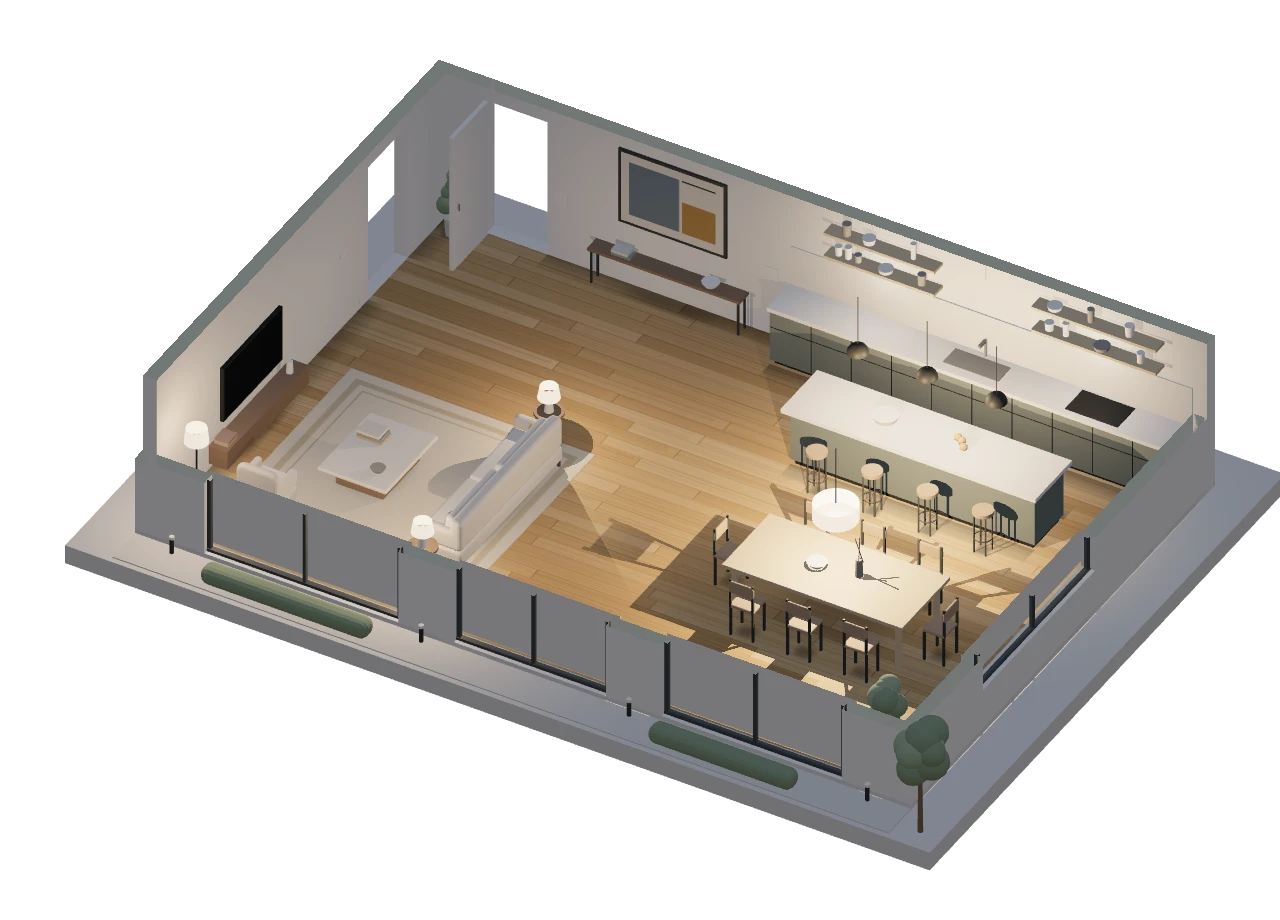
Dinner19:30
Warm light over the table and island, a low glow by the sofa, music quiet where people are. The shades closed as the street went dark. Nobody touched a thing.
Scene“Dinner”Keypad K2, or at sunset on weekdays
- LLight
- L3 dining 45% · L2 island 35% · L4 lamps 25% · 2700K
- SHShades
- SH1–4 closed at sunset + 20 min
- AAudio
- A1–4 grouped · low
- VVideo
- Off
- CClimate
- Hold 71°F
- SSecurity
- No change
Every space, device and scene in this home is named once, in one model. How it’s built
The problemDiagram
Most homes have systems. Few have a system.
Lights from one brand, shades from another. A thermostat with its own schedule, speakers with their own app, a remote for every screen. Each one works. Together, they don’t — and every one of them asks you to manage it.
An Attuned home starts from the other end: one model of the house, one set of scenes, and several natural ways to reach them.
Between the smart-home aisle and custom integration.
Off-the-shelf devices are affordable but fragmented. Custom integration is cohesive, but it has mostly lived in the most expensive homes. Attuned Home brings that cohesion — with more openness — to almost any home.
| Off-the-shelf smart devices | Attuned Home | Traditional custom integration | |
|---|---|---|---|
| How it comes together | Product by product | Designed as one system for your home | Designed as one system for the home |
| How you use it | An app for each brand | One consistent way, with several ways in | One interface, set up by a specialist |
| Choice of devices | Whatever works with the app you picked | A proven core, plus almost anything that can join your network | Largely the integrator’s chosen catalog |
| Who installs it | You | You, your electrician or a partner professional — from clear documents | The integrator’s own crew |
| Who it’s for | One device at a time | Almost any home, one room to the whole house | Mostly the most expensive homes |
The ideaSection
Technology composed around people and architecture.
Attuned means two things: a home that responds to the people in it, and systems tuned to work together. The aim isn’t more technology you can see. It’s technology integrated so thoroughly that it recedes into the architecture — and into the day.
What you noticeWhat’s composed behind it
Sunlight where you want it; privacy when you don’t.
Motorized shade in a recessed ceiling pocket; limits and presets set before installation.
A quiet ceiling, and music that seems to belong to the room.
In-ceiling speaker with paintable grille; zone and level set for the space.
Light that suits the hour.
Dimmable downlight on a scene-controlled zone; warm-dim in the evening where fixtures allow.
One keypad by the door, labeled in words.
Keypad at 48″ AFF, engraved: Welcome · Dinner · Watch · Goodnight.
Nothing at all.
Low-voltage control wiring to the equipment location, recorded in the home’s documentation.
The home is the product.
Not the collection of devices inside it. We design how each room should feel and behave, then choose the equipment that delivers it.
Architecture comes first.
Keypads where a hand expects them. Speakers and shade pockets that recede into the ceiling. Technology that supports the architecture instead of competing with it.
Complexity stays with the system.
Brands, protocols, apps and programming are resolved before they reach you. You live with scenes named for your life — not with subsystems.
How it comes togetherFour phases
Connect it. Live with it. Then build on it.
Every Attuned Home — do-it-yourself or professionally installed, one room or the whole house — grows through the same four phases. Nothing new is added until what’s underneath works the way you want.
-
Phase 1
Connect & map
We design the system, then program and test it in our lab wherever possible. You or your installer connect it, and every device is integrated and mapped into a model of your home — each space, device and scene named once.
Review · design · program & bench-test · document · install · commission
-
Phase 2
Live with it
Start simple: a few scenes, well-placed keypads, one app. Live with it for a while. The system reports what it’s doing, so we can confirm it behaves the way you want — and tune what doesn’t.
A few scenes · keypads · one app · tuning
-
Phase 3
Stack capability
When the foundation is right, add layers one at a time: schedules, presence, automations that span rooms and, as it matures, conversation. Each builds on something you already trust.
Schedules · presence · whole-house automation · conversation
-
Phase 4
Expand freely
Add rooms and systems whenever you’re ready, with real freedom to choose: a proven core where reliability matters, and almost anything that can join your network everywhere else.
More rooms · more systems · devices you choose
Install it your way.
The system, the documentation and our support are the same whichever path you choose — and support reaches you remotely, often faster than a service call.
For enthusiasts
Do it yourself
For technically comfortable homeowners. Equipment arrives programmed, tested and labeled wherever possible, with step-by-step guides, and we help you bring the system online.
Work on your home’s electrical wiring belongs with a qualified electrician — and in many places, it’s required.
For most projects
Your electrician or builder
Hand our installation set to the trades you already trust. They install; we handle design, configuration and programming, and answer their questions along the way.
For a hands-off project
A partner professional
Rather not coordinate it yourself? Ask us about installation partners in your area who know our systems.
How projects are priced
One complete package, whoever installs it.
You purchase the system as a complete package of specified equipment — the same package whether you install it yourself or hire a pro. We’ll walk you through what your package includes, and what it costs, before you commit.
What a system can bring together
A proven core where reliability matters most — today, Lutron lighting and shading control — and the freedom to bring in almost anything else that can join your network.
- L
Lighting & control
Light that suits the hour and the task.
Zones, keypads, scenes, fades, warm-dim where fixtures allow.
- SH
Shades & window coverings
Daylight, privacy and glare, handled.
Groups, limits, presets, sun-position and schedule logic.
- A
Audio
Music where you want it, at the right level.
Speaker placement, zones, grouping, level matching.
- V
Video
One press to watch.
Display and source integration, input logic, one remote.
- C
Climate & environment
Comfortable when you’re home, eased back when you’re not.
Thermostats, setbacks, schedules tied to scenes.
- S
Security & access
Doors that lock behind you; arrivals that feel the same every time.
Locks, access, security status, notifications worth having.
- P
Presence & occupancy
Rooms that respond when they’re in use.
Occupancy and vacancy sensing, used with restraint.
- U
Unified control & voice
One way to run the house — keypads, phone, and voice where it helps.
Control architecture, plain-language names, permissions.
Automated CraftsmenThe makers
Skilled craftsmen. The best tools we can build.
Attuned Home is made by Automated Craftsmen. We’re integration craftsmen first — and we’ve built our own tools to automate as much of our work as possible. The tools take the repetition. We keep the judgment.
That’s how integration once reserved for the most expensive homes becomes possible for almost any home — often with more openness than the systems that came before it.
What the craftsmen do
- Understand how you live and how the house is built
- Compose the system around the people and the architecture
- Choose the proven core, and what can join it
- Review what the tools produce
- Program and test devices on our bench before they ship
- Commission, tune, and stay with it afterward
What the tools do
- Read plans and understand the spaces
- Place devices and build the bill of materials
- Draw wiring and installation documents
- Write configuration and initial programming
- Load and exercise every device on the bench
- Check the finished system against the design
Inside the workshop: from plan to working system.
Follow the example home from its drawings to a commissioned system, one step at a time.
Read the drawings.
Architectural and electrical plans: walls, openings, rooms, dimensions and the way the house is meant to be used.
InputsExample
- A-101 Floor plan, main level
- A-201 Elevations and window schedule
- E-101 Electrical plan
- — Notes from your first conversation
Understand the spaces.
Rooms and how they connect, which way the windows face, where people gather — the relationships every later decision depends on.
SpacesWhat matters
- Entry Front door, keypad side, hall connection
- Kitchen Wall run and island, open to dining
- Dining South and east glazing, morning sun
- Living South glazing, media wall to the west
Recommend equipment.
Compatible components placed for the architecture and the way each room is used — from a focused family we know well.
PlacedCount
- Keypads 2
- Lighting zones 5 · 5 downlights, 4 pendants, 2 lamp circuits
- Motorized shades 4
- In-ceiling speakers 4 · 2 audio zones
- Climate · Access · Display 1 thermostat, 1 lock, 1 display
Produce the bill of materials.
Every device, tagged to the space it belongs to — the basis of the equipment package you receive.
Bill of materialsExcerpt
| Tag | Item | Qty |
|---|---|---|
| K1–K2 | Keypad, 4-button, engraved | 2 |
| L1–L5 | Lighting control zone | 5 |
| SH1–SH4 | Motorized shade, recessed pocket | 4 |
| A1–A4 | In-ceiling speaker | 4 |
| C1 · S1 | Thermostat · smart lock | 2 |
| EQ | Equipment enclosure, prepared | 1 |
Generate installation documents.
Circuits, home runs, device locations and details, written for the electrician who will install them — not for a programmer.
Installation setSheets
- T-101 Device plan
- T-201 Device schedule
- T-301 Wiring and home runs
- T-501 Details
- — Step-by-step installation guide
Configure and program.
Scenes, schedules and names, set before installation — and, wherever possible, loaded onto the devices and tested on our bench, so equipment arrives ready for its place.
ScenesExcerpt
- Welcome Door unlocked after sunset → entry 40, kitchen 50, hall 20
- Dinner K2 → dining 45, island 35, lamps 25, shades closed, music low
- Watch Remote → lamps 5, shades closed, display on
- Goodnight Bedside → all off, path light low, locked, 67°F
Validate and commission.
Once installed, the system is checked against the design — and tuned to how the household actually lives.
CommissioningChecklist
- ✓ Every load responds to its keypad
- ✓ Shade limits set; open and close verified
- ✓ Audio zones level-matched
- ✓ Scenes run from keypads, phone and schedule
- ✓ Lock and security states verified
- ✓ Household walkthrough and guide
Where this stands
Today, each step is led by a craftsman working with our tools, which makes design and programming faster and more consistent. The tools keep taking on more of the repetitive work — and a person still reviews every result.
Tested on our bench before it reaches your walls.
Programming and troubleshooting are slowest and most expensive in the field. So, wherever possible, we do them in our lab first.
In our lab
Programmed and tested before it ships.
Wherever possible, every device is configured, loaded with its programming and exercised on our bench — matched to its tag and labeled for its place — before it’s delivered.
Far fewer issues surface in the field, so work on site moves faster — for you, your electrician and your builder.
On site, during construction
A loaner startup kit: the whole system in a box.
Where a space is still under construction, we lend you everything the system needs in one case — the home controller running your project, network, Wi-Fi and power — plus internet access if the site doesn’t have it yet. Plug it in and devices can be powered up, tested and used without waiting for the permanent network, and we can support your installer remotely from the first day.
When the permanent network is ready, the system moves over and the kit comes back to us.
No waiting on the last trade to finish before the first device works — or before we can help.
Open by designA section through the system
Open underneath. Calm on top.
Attuned Home is designed around open-source home-automation software rather than a closed ecosystem. On top sits our own interface, and the tools we use to look after your system.
You live with a calm, consistent home. Underneath, it’s open to almost anything that can join your network — and never tied to one manufacturer.
Rooms, scenes and names you chose. One consistent way to live with the house, whatever is underneath.
Spaces · devices · relationships · scenes · presence
A widely supported foundation, not a walled garden.
Remote doesn’t mean out of reach.
A traditional service call starts with someone driving to you. Because every Attuned Home is built to be looked after, we can connect to your system — the way you allow it — see what it has been reporting and respond, often before a truck could have arrived.
A typical service callDepends on a drive
- You call
- A visit is scheduled
- Someone drives to you
- Diagnosis on site
- A return trip if parts are needed
Attuned Home supportStarts with a connection
- You or your installer ask
- We connect, the way you allow
- The system’s own signals show what happened
- Configuration issues fixed remotely
- If hands are needed, they arrive with the diagnosis done
Illustrative sequence · not to scale
Access the way you allow it.
You decide how we connect to your system. More in the general notes.
The diagnosis comes first.
The system reports what it’s doing, so we can often see what went wrong before anyone touches a device.
Hands, when hands are needed.
Physical problems still need someone on site. Your installer or a local professional goes in knowing what to do and what to bring.
Help from the first day.
With the startup kit on site — internet included where needed — support works even before the house is connected.
Everything rests on a model of the home.
Not a list of devices: a structured understanding of the house — its spaces, systems, devices, relationships and capabilities, and, when you allow it, who is where.
Because the way you interact with the home is built on that model rather than on any one product, equipment and manufacturers can change without anyone relearning the house.
- These shades belong to the dining area.dining · SH3, SH4
- The island pendants are part of the kitchen.kitchen · L2
- These speakers make up the kitchen audio zone.kitchen · A3, A4
- “Dinner” reaches across three connected spaces.kitchen · dining · living
- Someone is in the kitchen right now.presence · kitchen
Say it the way you’d say it.
Conversation is one of the layers you’ll be able to stack on. Here’s how it’s meant to work — choose a request to follow it through.
- Heard
- “Open the blinds halfway.”
- Context
- You’re in the kitchen. It’s 5:40 pm.
- Understood
- Kitchen blinds to 50%. No room was named, so where you are decides.
- Then
- A routine request — carried out right away by the home’s automation.
Done
Designed to process speech and household context on a device in your home whenever practical.
Intelligence proposes. Automation acts.
Language is flexible; a home shouldn’t be unpredictable. Intelligence interprets what you mean. Dependable, rule-based automation carries it out.
Some things always ask first.
Locks, security and anything that affects safety stay governed by explicit rules and appropriate confirmation.
The intelligence stays home.
Local first: the system runs in your home, and voice and household context are designed to be processed there whenever practical.
Freedom to choose.
Your home is modeled independently of any one product, so devices and manufacturers can change without anyone relearning the house.
ProfessionalsBuilders · Architects · Electricians
A dependable way to offer integrated homes.
Builders, architects and electricians can offer sophisticated automation without becoming programmers, network specialists or full-service integrators. The craftsmen and their tools carry the system; you keep doing what you do well.
Builders & architects
An upgrade you can offer on every project — without a custom process on every project.
Coordinated lighting, shading, audio and climate can set a home apart. Delivering it has usually meant a specialist firm and an unpredictable process. Attuned packages it.
- Predictable packages. Defined systems with clear scope, prepared the same way on every home that selects them.
- Your trades, your schedule. We deliver what your electrician needs at rough-in and at trim.
- The whole system in a box. Our loaner startup kit — controller, network and, where needed, internet — runs the system during construction, so devices can be brought up and checked before the permanent network exists.
- Design intent respected. We work from the drawings; devices are placed with the architecture.
- A handover clients understand. Scenes named in plain language, and a guide for the household.
Electricians & installation partners
Familiar installation work, with clear plans and real support.
You rough in, set devices and land wires. We handle the system thinking: design, compatible equipment, networking, configuration and programming.
- Clear plans. Device locations, schedules, wiring and details for every job.
- Bench-tested equipment. Programmed and tested in our lab wherever possible, so fewer issues surface on site and the job moves faster.
- Support when you need it. With the startup kit on site, we can connect remotely and answer questions from the first day — and help you commission at the end.
- No new trade to learn. You don’t need to become a programmer or an automation integrator.
| Tag | Device | Location | Rough-in |
|---|---|---|---|
| K1 | Keypad, 4-button | Entry, latch side, 48″ AFF to center | Backbox and conductors per detail 3/T-501 |
| L3 | Pendant, dining | Centered on table, per plan | Fixture box at ceiling · zone L3 |
| A1–A2 | In-ceiling speaker | Living, per plan | Speaker cable home run to EQ |
| SH2 | Motorized shade | South window W2, recessed pocket | Power and control at head, left side · detail 5/T-501 |
| EQ | Equipment location | Utility closet | Prepared enclosure arrives labeled · mount, land and power |
Where to beginPlan
Start with one room. Grow into the whole house.
Almost any home can start somewhere. Every project uses the same foundation, whether it’s a single room or a complete residence — so whatever you begin with can be extended rather than replaced.
One room
Lighting or shading done properly in the room you use most — composed, programmed and ready to join more rooms later.
Often a good fit forExisting homes, renovations, and anyone who wants to start small.
General notesQuestions
Questions we expect.
Who is Automated Craftsmen?
The company that designs and makes Attuned Home: integration craftsmen who have built their own tools to automate as much of the work as possible, so sophisticated systems can reach far more homes.
Can I install it myself?
Yes, if you’re comfortable with it. Equipment arrives prepared and labeled, with step-by-step guides, and we help bring the system online. Anything involving your home’s electrical wiring should be done by a qualified electrician — in many places, it’s required.
Is the equipment tested before it arrives?
Whenever possible, yes. We program and test devices in our lab before they ship, matched to their tags and labeled for their places — so far fewer issues surface in the field and work on site moves faster.
What if the house is still under construction?
We can lend you a startup kit with everything the system needs in one case — the home controller running your project, network, Wi-Fi and power, plus internet access if the site doesn’t have it yet. Devices can be powered up and checked without waiting for the permanent network, and we can support your installer remotely from day one. When the permanent network is ready, the system moves over and the kit comes back to us.
You’re not local. Who helps when something isn’t right?
We do — often faster than a traditional service call, because nobody has to drive to you first. We connect to your system the way you allow, see what it has been reporting and fix configuration issues remotely. When something physical needs hands, your installer or a local professional goes in with the diagnosis already done.
How does remote access work?
The way you allow it. When your system is set up, we agree how we can connect — for example, only when you or your installer ask for help, or on an ongoing basis if you’d like us to look after the system for you. You can change that as your needs change.
Do you install the system?
Usually not. You, your electrician or builder, or a partner professional installs it. We design the system, provide the equipment, prepare the documents, do the programming, and help with commissioning and support.
Can I use devices I already have?
Often, yes. Attuned Home is designed around open-source home-automation software, so if a device can be reached on your home network, there’s a good chance it can join. We’ll check during your review.
How are projects priced?
You purchase the system as a complete package of specified equipment — the same whether you install it or a pro does. We’ll walk you through what your package includes, and what it costs, before you commit.
Is this “AI for my house”?
No. The promise is simpler: your home, working as one. Behind the scenes, our tools automate much of the design and programming work. Conversation with your home is a layer we’re developing — and we label it that way.
Where does my information go?
Local first: the system is designed to run in your home, and voice and household context are meant to be processed there whenever practical. If you’d like us to look after your system, we’ll explain what we can see and why — and it’s your choice.
What if a product is discontinued, or I want to change brands?
Your home is modeled independently of any one manufacturer, so a device can be replaced without you relearning the house. We start you on proven components, and you’re free to choose others as you expand.
We’re electricians. Do we need programming experience?
No — that’s the point of the model. You install to clear device plans and instructions; we handle design, configuration, programming and networking for the system, and we’re available to your team during the job.
Where do you work?
Design and programming happen centrally, and installation is done by you or local professionals — so we work with homes nationwide, from our studio in Grand Rapids, Michigan.
Next stepInquiry
Start with a conversation — or send us your plans.
Homeowners, enthusiasts and professionals all begin the same way: a short conversation about the home and what it should do.
- info@attunedhome.ai
- Studio
- Grand Rapids, Michigan
- Coverage
- Homes nationwide
PrivacyUpdated September 2026
A simple privacy note.
This site doesn’t use cookies, analytics or advertising trackers.
When you send an inquiry, the form opens your own email app with your message filled in — nothing is sent until you send it. We receive what you choose to include, such as your name, email address, project location and message, and use it only to reply and to plan your project. We don’t sell it or share it for marketing.
The site is delivered by Cloudflare, which handles basic technical information such as IP addresses to serve and protect it. Fonts load from Google Fonts and the 3D model loads a library from cdnjs, so those services receive standard request information too.
How we connect to a home system, and what we can see, is agreed with you separately — see How does remote access work?
Questions, or want us to delete what we hold about you? Email info@attunedhome.ai.